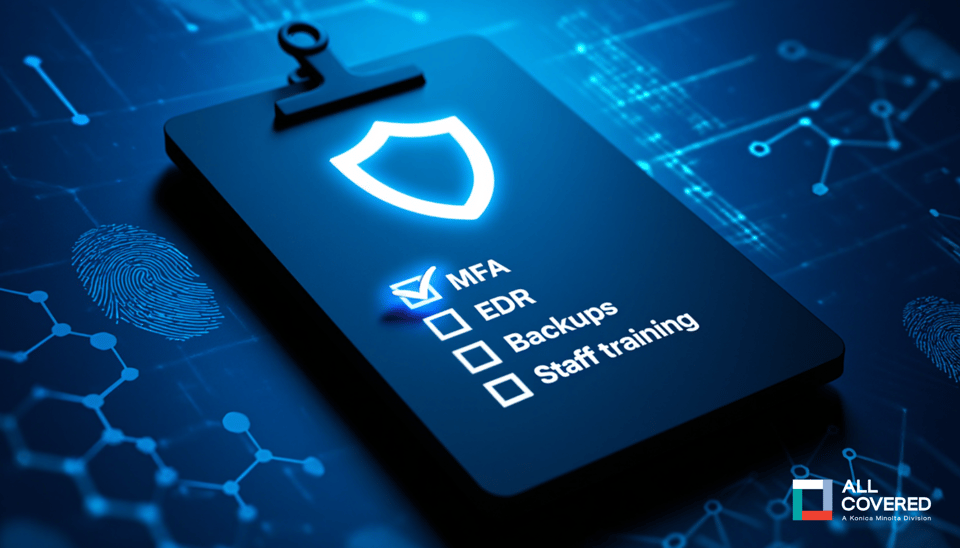

You already know that cyber risk is rising, while budgets and talent are feeling stretched. The result is alert fatigue, tool sprawl, and gaps that attackers love to exploit. The CIS Critical Security Controls (CIS Controls) offer a practical approach to address these issues.
Human error was a contributing factor in 68% of breaches during 2024. Controls like MFA, secure configuration, and training directly address that reality.
This guide explains what the CIS controls are, how to apply them, and what changes were made in version 8.1. You’ll see how teams use the controls to reduce attack surface across cloud, endpoints, networks, and vendors. You’ll also get a quick tour of the 18 controls, plus a checklist to start from.
What Are the CIS Controls?
The CIS Critical Security Controls are a set of prioritized safeguards that help teams defend against the most common digital attacks. They’re practical, community-developed best practices you can put to work right away to improve cyber hygiene and reduce risk.
Each of the 18 controls are broken down into specific, testable Safeguards. That structure makes implementation measurable and repeatable across cloud, endpoints, networks, and apps.
A quick note on fit with NIST:
NIST CSF sets the strategy and outcomes at a high level; CIS translates that intent into actionable steps that you can check off. The official mapping between CIS Controls v8.1 and NIST CSF 2.0 shows how they align, so you can plan with CSF and execute with CIS without duplicating effort.
Who Is the Center for Internet Security (CIS)?
The Center for Internet Security (CIS) is a nonprofit that convenes a global community to publish the CIS Critical Security Controls and CIS Benchmarks.
The Benchmarks are consensus-built hardening guides for operating systems, cloud platforms, and applications, mapped back to the Controls, ensuring teams maintain alignment between configuration and control objectives.
IBM’s 2025 Cost of a Data Breach Report puts the global average breach at $4.44 million, while the U.S. average rose to $10.22 million, providing ample evidence that strong hygiene and hardening matter immensely.
Public agencies use CIS to scale hygiene and audits. The State of Minnesota applied SecureSuite and CIS-CAT Pro to deploy and verify secure configurations across its departments and agencies statewide.
Why the CIS Controls Matter in 2026
CIS Controls focus on the breach paths that drive real losses: weak configuration, poor patch management and unpatched software, exposed accounts, and thin logging. Ransomware pressure remains high.
The FBI’s Internet Crime Complaint Center recorded $16.6 billion in cyber-enabled losses in 2024, and ransomware complaints affecting critical IT infrastructure rose 9% from 2023. These trends reinforce the need for Secure Configuration, Continuous Vulnerability Management, Account Management, Data Recovery, and Audit Log Management as day-one moves.
Crucially, the model scales to resource-constrained teams. For example, a Texas K-12 district adopted Implementation Group 1, used CIS SecureSuite tools, and quickly formalized policies and hardened Windows hosts, raising benchmark conformance in hours while working with a small staff.
How Organizations Use the CIS Controls in Practice
Security teams adopt the CIS Controls through Implementation Groups (IG1, IG2, IG3), which match safeguards to cyber risk and available resources.
IG1 covers essential hygiene; IG2 and IG3 add depth as complexity grows.
To connect strategy to action, map the Controls to NIST CSF 2.0 using CIS’s official whitepaper, then execute against the mapped safeguards.
For 92% of industries, ransomware is a top threat, so it makes sense to have backup, MFA, logging, and response planning as your first moves.
To see an example in practice, here is a case study of how one new CISO used a CIS SecureSuite membership to prepare for SOC 2 and speed control rollout, demonstrating how the model accelerates measurable progress.
What Changed in CIS Controls v8.1
The CIS v8.1 update realigns mappings to NIST CSF 2.0, expands the glossary for reserved terms, revises asset classes and their links to Safeguards, and fixes or clarifies several Safeguard descriptions.
More precise definitions mean assessors and teams use the same language, which cuts audit friction and makes evidence collection more consistent. The refreshed asset classes and CSF alignment also help large, hybrid environments keep cloud, endpoint, and network workstreams on a single track without translation gaps.
The 18 CIS Critical Security Controls at a Glance
The CIS Controls are the official, prioritized list of 18 focus areas that turn security strategy into day-to-day practice. Below are the control names from CIS with a quick explanation of what each helps you do.
1. Inventory and Control of Enterprise Assets: Keep a real-time inventory of your critical infrastructure: devices and IT systems. Allow only authorized assets and remove or isolate anything unknown.
2. Inventory and Control of Software Assets: Track all software. Block or remove anything unauthorized.
3. Data Protection: Classify data and apply safeguards so sensitive information stays encrypted, minimized, and monitored.
4. Secure Configuration of Enterprise Assets and Software: Establish hardened baselines and manage changes so settings don’t drift.
5. Account Management: Manage the full lifecycle of accounts. Disable stale access and enforce least privilege.
6. Access Control Management: Grant the right access at the right time. Enforce MFA and just-in-time access controls where possible.
7. Continuous Vulnerability Management: Scan, prioritize, and remediate vulnerabilities on a regular cadence.
8. Audit Log Management: Collect, retain, and review logs. Send them to a SIEM to speed detection and investigation.
9. Email and Web Browser Protections: Harden clients and filter dangerous content to reduce phishing and drive-by risk.
10. Malware Defenses: Use preventive and behavioral controls such as EDR to stop, detect, and quarantine malware.
11. Data Recovery: Back up critical data and test restores. Keep offline or immutable copies. This helps maintain business continuity and aids with disaster recovery if the worst-case scenario were to happen.
12. Network Infrastructure Management: Inventory and securely configure routers, switches, firewalls, and cloud security. Segment where it reduces risk. In modern cloud and hybrid environments, organizations often need flexible ways to scale their network infrastructure across distributed systems. This includes managing IP allocation, segmentation strategies, and connectivity between multiple environments. In large-scale deployments, organizations may also rely on externally sourced address space, including solutions to lease IP, to support scalable network segmentation and distributed infrastructure design.
13. Network Monitoring and Defense: Detect suspicious traffic and block known-bad activity.
14. Security Awareness and Skills Training: Train people regularly and tailor modules to roles and current threat intelligence.
15. Service Provider Management: Vet third parties, write security into contracts, and monitor performance.
16. Application Software Security: Build security into the SDLC with code review, dependency management, and testing.
17. Incident Response Management: Plan, assign roles, run exercises, and capture lessons learned.
18. Penetration Testing: Validate controls and find gaps with planned testing and red-team exercises.
Get Expert Help with CIS Controls
The CIS controls provide a straightforward way to mitigate risk and demonstrate progress. Start by matching your IG level to your risk, then lock in the first set of safeguards that shrink your attack surface.
If you want help turning the strategy into daily practice, All Covered can stand up monitoring, vulnerability management, incident response planning, and recovery with a security-first approach.
Explore All Covered’s managed security services to accelerate your rollout and build resilience with a partner that lives this work every day.