NIST CSF Explained: A Guide to Stronger Cybersecurity
If you’re responsible for protecting your organization’s data, you’ve likely heard of the NIST Cybersecurity Framework (NIST CSF) But what is it exactly, and why does it matter?
In this article, we’ll break down what the NIST CSF is, how it works, and why it’s one of the most widely adopted cybersecurity frameworks today. You’ll also learn how it compares to other frameworks like CIS Controls, so you can decide if it’s the right fit for your organization.
What Is the NIST CSF?
The NIST Cybersecurity Framework (CSF) is a flexible set of guidelines created to help organizations manage and reduce cybersecurity risk. It was designed by the National Institute of Standards and Technology (NIST) in 2014, following Executive Order 13636, which called for enhanced protection of the nation’s critical infrastructure.
While the original goal was to help power grids, hospitals, and other essential services enhance their defenses, the framework proved to be incredibly useful for any organization, big or small, public or private, tech-savvy or not. It’s structured to be scalable and adaptable, meaning you don’t need a massive security team (or budget) to use it.
And clearly, it's working: 40% of organizations say NIST is their primary cybersecurity framework, making it the most widely adopted one out there. Whether you're a Fortune 500 or a small nonprofit, NIST CSF gives you a roadmap to make smarter, more confident security decisions.
Why the NIST CSF Still Matters
A decade after its debut, the NIST Cybersecurity Framework is more relevant than ever. Amidst evolving threats and rising cyber insurance costs, it provides organizations with a clear and flexible way to strengthen their defenses, without getting bogged down in technical jargon or red tape.
One of its biggest strengths is that it connects the dots between security and the business. By aligning cybersecurity efforts with business goals, the NIST CSF helps leadership and IT speak the same language. That makes it easier to prioritize risks, justify budgets, and make informed decisions.
Take the University of Chicago’s Biological Sciences Division, for example. With 23 departments and a fragmented IT structure, security was scattered and inconsistent. Adopting the NIST CSF helped unify their approach, align risk expectations, and create a more effective roadmap.
Alex Lekander, a cybersecurity expert at Cyber Insider, says the business alignment angle is one of the framework's most underappreciated aspects. "Security teams often struggle to justify spend to leadership, and NIST CSF gives them a common language to do exactly that," he says. "The insurance premium data points are a useful reminder that good security posture has tangible financial consequences, not just risk consequences."
There’s even a financial upside: Organizations using the NIST CSF report a 33% slower growth in cyber insurance premiums compared to those that don’t.
The NIST CSF Core: Six Key Functions
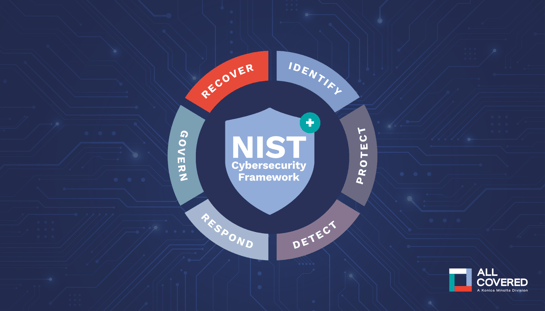
At the heart of the NIST Cybersecurity Framework are six core functions that help organizations establish a robust, adaptable, and repeatable approach to managing cyber risk. Here’s a quick breakdown:
- Govern: The newest function, added in the 2.0 update, focuses on aligning cybersecurity risk with business strategy.
- Define roles and responsibilities
- Set cybersecurity policies and oversight
- Ensure compliance and accountability
- Identify: Understand what you’re working with and what’s at risk.
- Inventory devices, applications, and data
- Spot vulnerabilities and assess risk
- Protect: Implement safeguards and protective technology to keep threats at bay.
- Implement access controls
- Train users
- Secure sensitive data
- Detect: Know when something’s wrong...fast.
- Use continuous monitoring
- Detection processes to identify anomalies and potential threats
- Respond: Act quickly and effectively in the event of an incident.
- Develop incident response plans
- Coordinate communications and contain the impact
- Recover: Get back on your feet with recovery activities and improve from the experience.
- Restore systems and services
- Analyze what happened and strengthen defenses
These functions provide a shared language for managing cyber threats, facilitating easier communication across technical and executive teams.
Profiles and Tiers: How the NIST CSF Adapts to You
One of the best things about the NIST Cybersecurity Framework? It’s not one-size-fits-all. The CSF is built to flex with your organization’s size, industry, goals, and risk tolerance, and that’s where Profiles and Tiers come in.
Profiles are like a before-and-after snapshot of your security posture.
- Your Current Profile shows where you are now, based on your existing security practices.
- Your Target Profile is where you want to be, based on business needs, risks, and compliance goals.
By comparing the two, you can identify exactly where the gaps lie and develop a plan to close them.
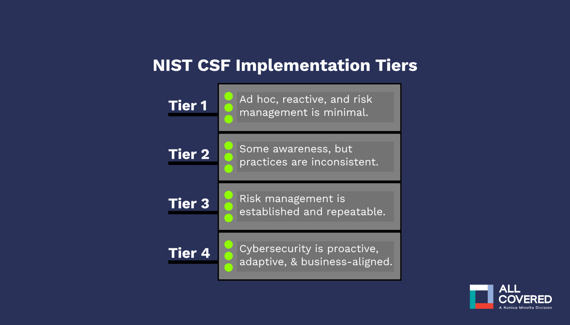
Then there are Implementation Tiers, ranging from Tier 1 (Partial) to Tier 4 (Adaptive). These aren’t scores or grades. Instead, they reflect how well cybersecurity is integrated into your organization’s processes and decision-making.
- Tier 1: Ad hoc, reactive. Risk management is minimal.
- Tier 2: Some awareness, but practices are inconsistent.
- Tier 3: Risk management is established and repeatable.
- Tier 4: Cybersecurity is proactive, adaptive, and business-aligned.
Organizations are encouraged to self-assess and select the tier that best describes their current approach to cybersecurity risk management. More than being about passing a test, it’s about understanding your level of risk awareness and how proactively cybersecurity is handled across your teams.
Tiers help leadership and security teams have realistic conversations about where the organization stands and how much risk they’re currently accepting. Combined with your profiles, your tier level provides a starting point for planning improvements and justifying new security investments.
Think of it like this: Profiles help you define your cybersecurity goals, while Tiers describe how deeply cybersecurity is woven into your operations.
Together, they help you make smart, realistic decisions about where to invest in security, based on your business priorities and how much risk you’re willing to accept.
How the NIST CSF Compares to CIS Controls
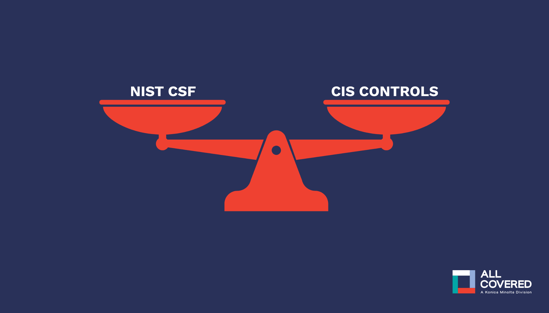
NIST CSF and CIS Controls often get mentioned in the same breath, but they’re not the same thing:
The NIST Cybersecurity Framework is the big-picture strategy. It’s high-level, flexible, and designed to help you align cybersecurity with business goals. It helps you figure out what you should be doing, without prescribing exactly how to do it.
CIS Controls are more prescriptive in nature. They give you a prioritized, practical set of specific actions that you can actually implement, like configuring firewalls or limiting admin privileges. CIS is especially handy for smaller teams that need clear steps and guidance.
In short:
- NIST CSF = Strategic, broad, flexible
- CIS Controls = Tactical, detailed, implementation-ready
And you don’t have to choose between them: these two frameworks work well together. You can use the NIST CSF to define your cybersecurity goals and risk tolerance, then apply CIS Controls to help you actually achieve them.
We’ll go deeper into how to use CIS Controls in the following article of this series, so stay tuned.
Who Should Use the NIST CSF?
The NIST Cybersecurity Framework isn’t just for Fortune 500s or government agencies. It’s designed to work for organizations of all sizes, from large enterprises to small and mid-sized businesses (SMBs). Whether you have a mature security program or you're just getting started, the CSF provides a scalable structure that fits your needs.
It’s especially valuable if you need to report cybersecurity posture to leadership, board members, or regulators. CIOs, CISOs, risk managers, and security teams all utilize the framework to communicate priorities, establish strategy, and monitor progress.
The CSF is also beneficial in third-party risk management, enabling organizations to assess vendors and partners against a consistent set of standards. If your business is part of a supply chain, utilizing the NIST CSF can enhance trust and transparency throughout your ecosystem.
Common Misconceptions About the NIST CSF
Many organizations misunderstand the NIST CSF, and that can hold them back.
- “It’s only for government agencies.” While 82% of federal IT security personnel do use parts of the CSF (according to Dell), 50% of private companies also leverage it. Clearly, it’s not limited to the public sector.
- “It’s too complicated for small businesses.” In reality, the framework is modular and flexible by design, so even resource-strapped teams can adopt it gradually.
- “We have to follow it perfectly.” Not true. The CSF is more of a guide that can be adapted to your business environment rather than a rigid checklist. With the release of CSF 2.0, the framework is even more dynamic and responsive to change, making it a living tool for today’s cyber challenges.
What's New in NIST CSF 2.0?
Released in 2024, NIST CSF 2.0 is the framework’s first significant update in a decade. This version introduces a sixth core function, "Govern," emphasizing stronger cybersecurity oversight, accountability, and strategic alignment.
It also reflects growing concerns about supply chain risk management and stresses the importance of continuous improvement in security practices.
CSF 2.0 features clearer implementation examples, making it easier for organizations to apply theory in practice. Overall, the update helps modernize the framework to better align with the complex and evolving threat landscape of 2025 and beyond.
How Do You Actually Use the NIST CSF?
In this article, we explored the what and why of the NIST Cybersecurity Framework. You learned what the CSF is, why it remains essential in 2025, and how its core functions, profiles, and tiers work together to create a flexible, scalable approach to cybersecurity.
So, what’s next?
If you’re ready to move from understanding to implementation, we’ve got you covered. Our NIST CSF Checklist breaks down how to assess your Current Profile, define your Target Profile, and build a practical plan to improve your cybersecurity posture—one step at a time.
Download the NIST CSF Checklist to get started on putting the framework into action for your organization. It’s your next move toward smarter, stronger, and more strategic cybersecurity.